Before the Recipe Book: How Cooking Knowledge Traveled
Cooking knowledge before printed recipe books traveled through speech and practice; learn what oral teaching preserved and what handwritten notes left out.
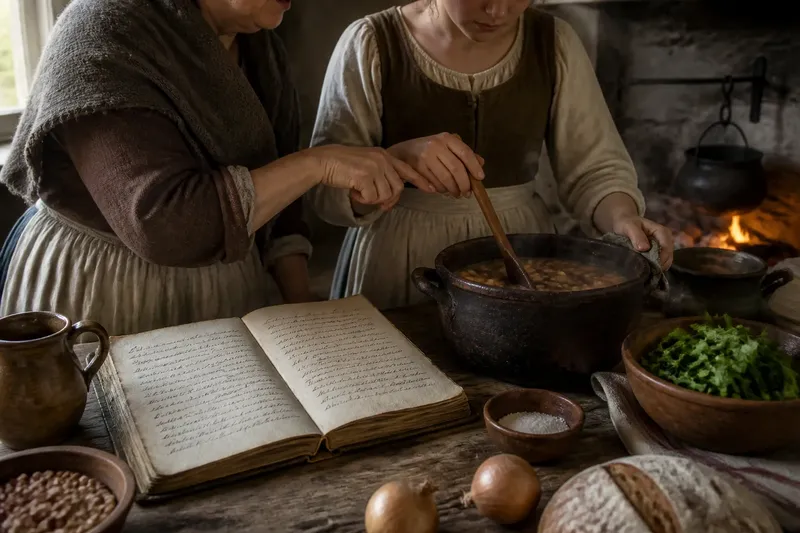
Cooking knowledge before printed recipe books took different forms across households and periods. In parts of Europe, for example, handwritten recipe collections circulated among some households before printing made cookbooks more widely available; meanwhile, cooks in many places continued to teach through conversation and shared work. There was no single path from spoken instruction to the printed page.
What could spoken cooking instructions carry?
A spoken direction could change with the food in front of the cook. “Add flour until it feels right” is not a fixed quantity; it asks the learner to compare the mixture with a remembered texture. A teacher could respond immediately when a learner hesitated or moved too quickly.
That flexibility had a cost. A phrase such as “a good handful” depended on the speaker’s hand and the listener’s interpretation. Instructions might omit familiar details because no one thought they needed saying: which pot to use, how hot the hearth should be, or what properly cooked grain looked like.
Spoken teaching could also pass on social knowledge. A learner might hear when a dish was served, which relatives were expected to help, or how a preparation changed for a feast day. In many households, cooking lessons were folded into ordinary work rather than announced as formal instruction.
Why did household practice matter?
Repeated chores made lessons visible. A child might see a parent sort lentils, rinse a wooden bowl, or turn bread near the fire before being asked to do the task. Familiarity built sensory clues: the sound of a simmer, the smell of browning onions, or the look of a surface ready for the next ingredient.
Households could also teach through divided labor. One person might tend the fire while another kneaded dough; a younger cook could begin by washing greens or fetching water. This arrangement kept a meal moving while making a skill easier to acquire in parts.
Access to those tasks was not equal in every household. Work could be divided by age, gender, status, or household role, and some knowledge stayed with particular people. A family’s cooking tradition therefore reflected both shared routines and boundaries around who was allowed to learn them.
What did handwritten recipe collections preserve?
Handwritten recipe collections could gather instructions that had lived in memory or conversation. A household notebook might hold recipes copied from relatives, neighbors, servants, or printed sources, sometimes alongside remedies, household accounts, and notes about occasions. Its pages brought several cooks’ knowledge together, though not necessarily in their own words.
A manuscript recipe was rarely a complete script. It might name ingredients and a sequence but leave out heat, duration, or a sign of doneness. A phrase like “bake until ready” still assumed that the reader knew the oven and the desired result.
Handwriting also reveals selection. Someone chose which recipes to copy, revise, or leave unwritten. A collection can preserve a household’s preferences, but it cannot stand in for every cook whose labor contributed to those dishes.
How did spoken, practiced, and written knowledge differ?
- Speech allowed questions and quick adjustment, but details could shift as instructions passed between people.
- Practice taught touch, sound, and timing through repetition, but often depended on access to a knowledgeable cook.
- Handwriting kept names and sequences together, but could not reliably capture every sensory cue.
These forms worked together rather than replacing one another. A learner could read an ingredient list, hear a relative describe the texture, and then practice under supervision. Like a map beside a walking companion, a written note can orient someone while the person nearby points out what the page cannot show.
Say a novice has a handwritten instruction for stew that says to add beans “when nearly tender.” A relative explains that the beans should yield at the edge but remain intact, then watches the novice check the pot. The note carries the sequence, the spoken cue gives a sensory target, and practice helps the novice repeat the judgment.
What questions help you read an old recipe?
Why are quantities sometimes missing?
The writer may have expected the cook to know the ingredients and household tools already. Quantities might also have been adjusted from memory or judged by sight and touch rather than recorded as fixed amounts.
What can a recipe’s wording reveal?
Repeated phrases may point to shared kitchen vocabulary, while an unusual ingredient or serving note can suggest a household preference. Treat these clues as evidence of how someone cooked, not as a full account of everyone who ate the dish.
How can you interpret an incomplete direction?
Look at the surrounding sequence: when an ingredient enters, what preparation comes before it, and how the finished dish is described. If a missing detail affects food safety or an ingredient’s handling, use current, reliable guidance rather than guessing from an old note.
How can you record cooking traditions now?
When recording a family recipe, keep the cook’s words alongside a clearer working version. Note the vessel, the appearance or feel that signals a transition, and any seasonal or ceremonial context the cook considers essential. A brief audio recording can preserve cadence and vocabulary that a tidy transcription might erase.
Ask permission before sharing someone else’s recipe or personal story beyond the family. Credit the people who taught and adapted it, and mark uncertain details as uncertain instead of smoothing them into false precision. Those choices preserve both the dish and the relationships through which its knowledge moved.
Cooking knowledge before printed recipe books is easiest to understand by reading a page alongside the practices and people it leaves out. A missing measure or familiar gesture may point to knowledge that was assumed rather than recorded. When you encounter an old instruction, distinguish what the words establish from what the cook must infer; that boundary is part of the recipe’s history.