The Natural Label Does Not Tell the Whole Story
Learn how to read a natural food label by checking ingredients, nutrition facts and claim wording, so you can choose products that fit your needs.
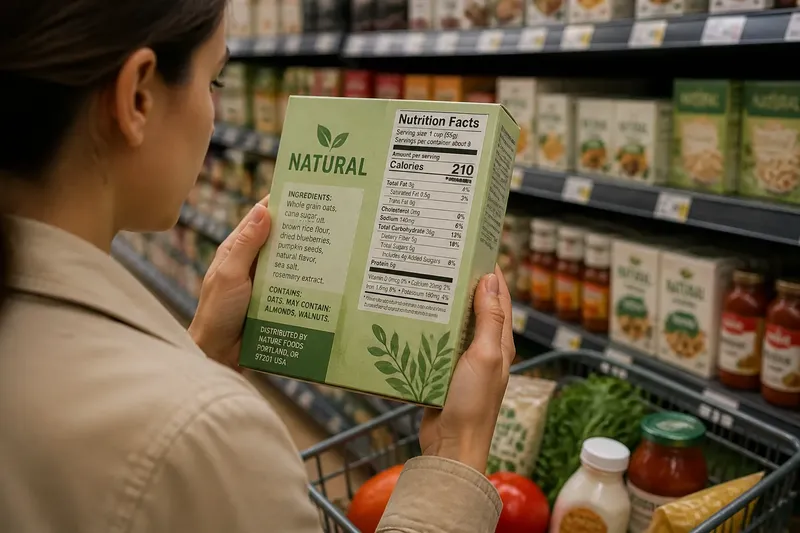
You pick up a box marked “natural” and still cannot tell whether it suits your needs. A natural food label in the United States is not a complete account of a product’s ingredients, processing or nutritional qualities; the ingredient list and Nutrition Facts panel offer more specific details. Rules and interpretations can differ by jurisdiction and product category, so the word alone is not a reliable guide to what a claim means where you shop.
What does “natural” tell you?
On packaged foods, “natural” can sound like a clear description, but its meaning depends on the applicable rules and the kind of product. In the United States, federal guidance for certain food labeling contexts has focused on whether something artificial or synthetic has been added that would not normally be expected in the food. That guidance is limited; it does not make the word a complete description of production or nutrition, and other jurisdictions or product categories may treat claims differently.
The word does not tell you whether a food is low in sodium, sugar or saturated fat. Nor does it establish that a product is minimally processed, made without a particular ingredient, or suitable for a dietary restriction. Those questions require closer reading.
Think of the word as a broad sign on a shelf, not a map of every turn in the recipe. It may be one consideration, but it cannot answer several different questions at once.
Which label details answer your question?
Start by identifying what you actually need to know. Then look at the part of the label designed to answer it:
- Want to know what is in the food? Read the ingredient list. Ingredients are generally listed in descending order by weight, so items near the beginning make up more of the product than those near the end.
- Watching a nutrient? Check the Nutrition Facts panel for the amount per serving. Compare products using the same serving basis, and consider how much you expect to eat rather than assuming one package serving matches your portion.
- Avoiding an allergen? Read the ingredient and allergen information carefully. Do not rely on “natural” as a signal that a food is safe for you.
- Curious about processing? Look at the ingredients and the product’s description, while recognizing that a short ingredient list alone does not reveal every processing method.
These sources answer different questions. The ingredient list describes components; the Nutrition Facts panel summarizes selected nutrients. Neither one, on its own, tells the whole story of a food’s origin or production.
How should you choose in different situations?
Are you mainly looking for a short ingredient list?
Read the list rather than treating “natural” as a promise of simplicity. If you recognize the ingredients and they fit your preferences, the product may suit you; if you want to know what an unfamiliar ingredient does, seek a reliable explanation before deciding.
Are you comparing foods for everyday nutrition?
Compare the Nutrition Facts panels for the nutrients that matter to you, such as sodium or added sugars, and check the serving information. A “natural” claim cannot tell you which option better fits your eating pattern.
Are you choosing food for an allergy or intolerance?
Use the ingredient and allergen statements, not the front-of-package wording. If you have a serious allergy or are unsure how to interpret a label, ask a qualified health professional for advice tailored to you.
Are you trying to avoid a particular production method?
Look for a specific, relevant statement or certification and find out what it covers. “Natural” alone does not identify a growing, handling or processing method, so it cannot resolve that choice.
What can the ingredient list reveal?
The ingredient list can help you spot familiar foods, sweeteners, oils, flavorings and other components. It also helps distinguish products whose front labels use similar language but whose recipes differ.
Say you are choosing between two jars of tomato sauce because both say “natural.” Imagine one lists tomatoes, herbs and salt, while the other also lists added sugar and several flavoring ingredients. If you want a simpler list, the first appears closer to that preference; if you are watching sodium, you still need to compare the Nutrition Facts panels before choosing.
This example illustrates why one label feature should not stand in for another. A shorter list does not automatically mean a food is more nutritious, and an unfamiliar ingredient does not by itself show that a product is harmful.
What label claims need a closer look?
Front-of-package wording is designed to be noticed quickly. Treat it as a prompt to check the details, not as a complete description. Terms such as “natural,” “made with” or “no added” may refer to different aspects of a product, so read the exact wording and check what the package says about its ingredients and nutrients.
Labels can also use serving sizes that make side-by-side comparisons less straightforward. For a fair comparison, use the same amount of each food where possible, and account for how much you normally eat. This is especially useful with snacks, drinks and sauces, where the amount poured or served may differ from the panel’s stated serving.
For claims governed by a particular label, manufacturer directions or local rules, check the relevant wording once rather than assuming the term has the same meaning everywhere. When a health condition or strict dietary need is involved, a qualified professional can help interpret choices that a general label cannot settle.
How can you make a quick, informed choice?
Use a simple sequence in the aisle: name your priority, find the label section that addresses it, compare the relevant details, and decide whether the product fits. If the priority is taste or convenience rather than a specific ingredient or nutrient, you can weigh those preferences openly instead of asking “natural” to answer for you.
For someone looking for a particular flavor, the ingredient list may be the deciding detail. For someone limiting a nutrient, the Nutrition Facts panel matters more. For someone avoiding an allergen, the ingredient and allergen information takes priority. The same package can suit one person’s needs and fail another’s, without the front label changing.
Reading a natural food label well means treating the word as limited information, then turning to the details that match your reason for buying. If you are unsure how local rules apply to a claim, check guidance from the relevant food regulator; if the choice affects a medical diet or serious allergy, ask a qualified professional.